Precision at its Finest: Elevate Your Lab Experiments with Global Lab Supplies


Furnace Chamber And Tile


GLS has various shapes of horseshoe-shaped furnaces, furnace tubes, electric furnace tile plates, rails, large-span muffle furnaces, etc. Used in various heat treatment furnaces, such as muffle furnaces, enamel sintering furnaces, diffusion furnaces, slats of various kilns, flameproof materials, etc.
Good thermal conductivity, stable thermal shock, corrosion resistance
The main raw material of the furnace chamber and tile is silicon carbide, which is equipped with various binders according to the requirements of the customers, and is formed by high pressure. The product has high thermal conductivity, good thermal shock stability, corrosion resistance and good wear resistance. We have various shapes of horseshoe-shaped furnaces, furnace tubes, electric furnace tile plates, rails, large-span muffle furnaces, etc. Used in various heat treatment furnaces, such as muffle furnaces, enamel sintering furnaces, diffusion furnaces, slats of various kilns, flameproof materials, etc.
Physical and chemical properties:
- The high-density Sic radiant tube has good thermal conductivity, stable thermal shock, corrosion resistance and no water leakage. For heat treatment, carburizing furnace can replace heat-resistant stainless steel pipe, durable and economical.
- Large-span muffle furnace bricks have high compressive strength, high bulk density, good wear resistance, good thermal conductivity and thermal shock stability.
[ Physical And Chemical Parameters ]
| Sic | >70%-85% | >90%-95% |
| FE2O3 | <1.0 | <1.0 |
| Density | >2.3-2.5 g/cm3 | >2.6-2.8 g/cm3 |
| Room Temperature Pressure | >40-60 Mpa | >70-80 Mpa |
| Shrinkage after Reheating | <0.5% | <0.1% |
| 0.2Mpa Load Softening Temperature | 1500°C | 1550°C |
Related Products

Bullion Blocks
Magnesia Bullion Block is a shallow, porous block with multiple holes, made from pure Magnesite, in which gold or silver can be refined or assayed by melting with a blast of hot air which oxidizes lead or other base metals.
Bullion Blocks are specifically designed to stand longer in the extreme heat of furnaces. These blocks are great heat conductors and high efficient to use.
These do not not crack or break over the course of time as well as demands no maintenance. Moreover, these Blocks are extremely durable and available in various specifications.
Alumina Ceramic
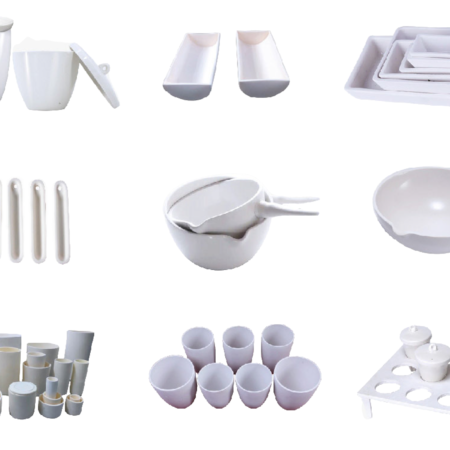
Alumina ceramic crucibles and corundum ceramic crucibles include: arc alumina crucibles, square alumina crucibles, rectangular alumina ceramics crucibles, cylindrical ceramic crucibles, and various special-shaped alumina ceramics crucibles. We undertake all kinds of non-standard and special-shaped alumina corundum ceramic crucibles, please contact us! Corundum ceramic crucible series: suitable for various laboratory metal and non-metal sample analysis, and various industrial analysis.

Fire Assay Crucible
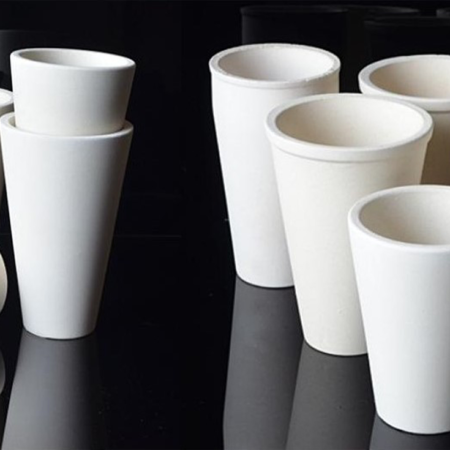
Gold Smelting Crucibles As Name of Fire Assay Crucibles,have a higher than normal resistency to cracking under fire assay conditions. Our crucibles and refractory products are used in laboratories throughout international marketplace. Our Crucibles can be used for 3-5 times. We have a variety of shapes and sizes available to cater to specifications required.
![Zirconium Crucibles [low form]](https://globallabsupplies.com/wp-content/uploads/2024/02/Untitled-1-450x450.png)
Zirconium Crucibles [low form]
Zirconium exhibits superb corrosion resistance in most organic and inorganic acids, salt solutions, strong alkalis and a few molten salts.
The passive oxide film (corrosion barrier) is stable in both reducing and oxidizing conditions. Zirconium is excellent in both acid and base solutions.
The temperature limit for use in air is
about 450˚C to 500˚C.


Tungston Carbide Bowls
The series of grinding bowls of Global Lab Supply has good wear resistance and impact resistance. A unique range of bowls from 40 to 5000g nominal capacity. Global Lab Supplies delivers this high-capacity, high production bowl to the sample preparation needs.

![Zirconium Crucibles [straight wall]](https://globallabsupplies.com/wp-content/uploads/2024/02/Untitled-1-1-450x450.png)
Zirconium Crucibles [straight wall]
Zirconium is our most effective crucible material for fusions using sodium carbonate or sodium peroxide. It is an excellent low-cost replacement for platinum. And, based on an average of 100 fusions per crucible, it is more cost effective than less expensive porcelain or steel crucibles.
Other advantages of zirconium are its complete resistance to the action of most solvents of all concentrations such as nitric, hydrochloric, sulfuric and perchloric acids.
This allows the fusions to be dissolved out of the crucible completely with little or no contamination of the sample. Alkaline solvents such as ammonium hydroxide, acetate sulfide, carbonate and (Na, K) hydroxide, sulfide, carbonate and cyanide are also without effect.